
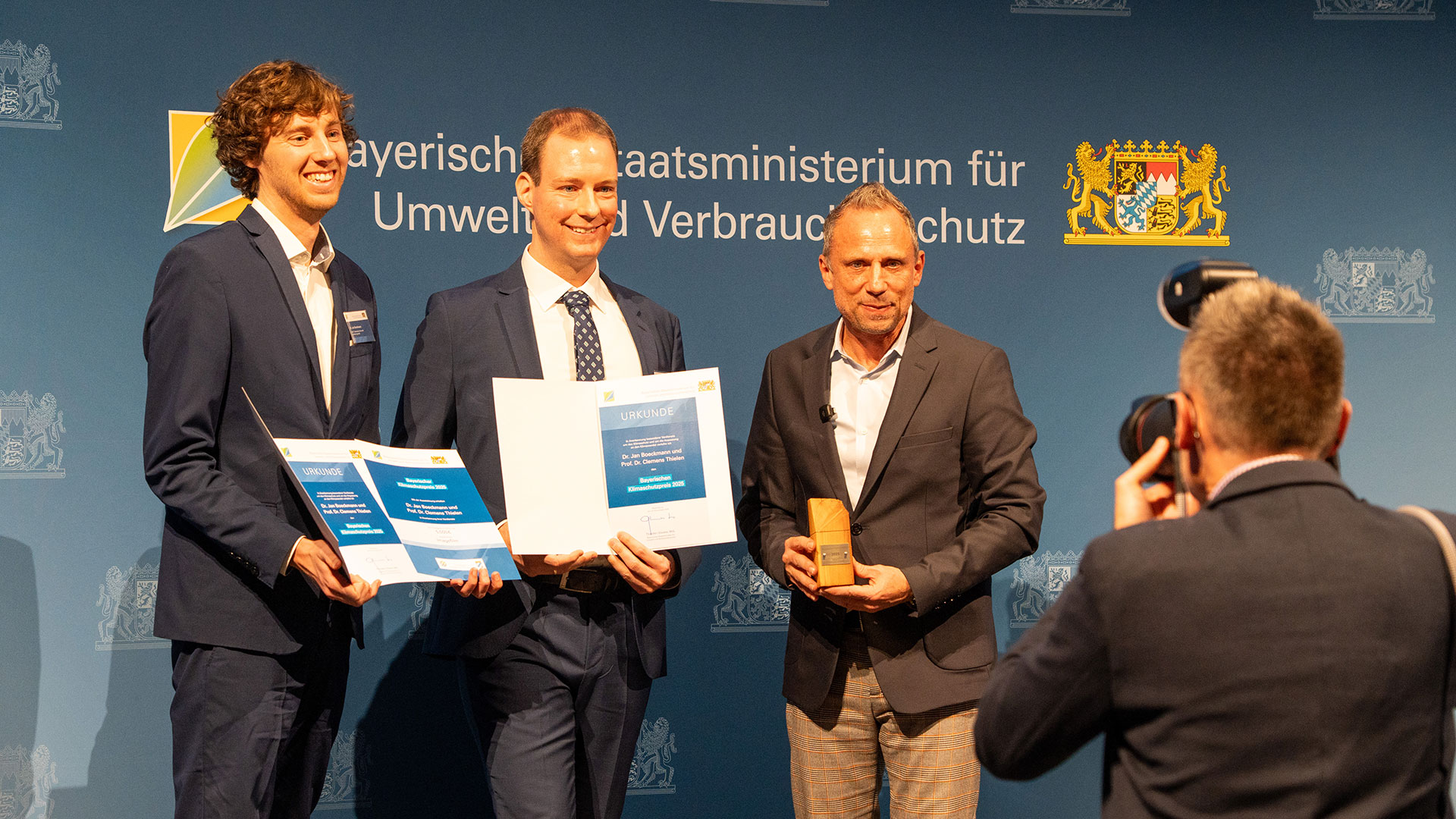
The AKUT project, which was developed as part of a research project at TUM Campus Straubing for Biotechnology and Sustainability, uses state-of-the-art optimisation and AI methods to create fully automated heavy rain hazard maps and efficient heavy rain prevention concepts and visualise them interactively. Heavy rain events are increasing significantly in both intensity and frequency as a result of climate change. The project is primarily aimed at local authorities that want to protect themselves by developing optimal heavy rainfall prevention concepts. Together with project partners from science and practice, a web application has been developed that enables local authorities to create such a concept automatically and free of charge for the first time. This is particularly beneficial for small local authorities that have only a limited budget available for planning.
Minister of State Glauber said: "Climate protection is a participatory project. We can only tackle climate change together. We want to recognise and publicise exceptional achievements and commitment to climate protection. That is why we award the Bavarian Climate Protection Prize. The four award winners work creatively, with dedication and perseverance to find solutions for climate protection and climate adaptation. Their exciting projects are new beacons for climate protection in Bavaria."
With the Climate Protection Prize, the Bavarian State Government honours special commitment to climate protection or adaptation to the effects of climate change. This year, the Bavarian Climate Protection Award is endowed with a total of 25,000 euros and has been presented for the fifth time in 2025.
The prize, which is enshrined in Article 11 of the Bavarian Climate Protection Act, is awarded to private individuals as well as companies, institutions or associations that have made a special contribution to climate protection or adaptation to the effects of climate change. The award is presented to all winners equally and without ranking. The competition is organised by the State Agency for Energy and Climate Protection (LENK).