
So-called ‘green’ hydrogen is produced by electrolysis of water, a process that uses electricity to split water into hydrogen and oxygen. This hydrogen can then be used in a fuel cell to produce electricity without emitting greenhouse gases. It is therefore a clean energy carrier, i.e. a sustainable method of storing and releasing energy.
However, although this technology has been known for a long time, its large-scale development remains complex. One of the main challenges is to design effective and inexpensive catalysts capable of producing and oxidising hydrogen. Today, these catalysts are based on platinum, a rare and expensive metal, which is already in high demand in other industrial sectors.
Inspiration from nature: bacterial hydrogenases.
In nature, many bacteria also use hydrogen as an energy source or carrier. They produce it using enzymes called hydrogenases, whose active sites, essential for the reaction, are made up of abundant and inexpensive metals such as iron.
These hydrogenases are attracting considerable interest because they could serve as natural catalysts in energy devices. The problem is that they are fragile: most cannot tolerate oxygen or oxidising environments. Finding an “ideal” hydrogenase that is efficient, stable, oxygen-resistant and inexpensive to produce is therefore a major research goal. And although this perfect enzyme has not yet been discovered, recent progress has been considerable.
Biologists from numerous teams around the world have understood how these enzymes are produced in bacteria and have developed methods for producing so-called ‘iron’ hydrogenases at low cost and in large quantities. In addition, exploration of the biodiversity of hydrogenases has led to the discovery of new ones with unexpected properties.
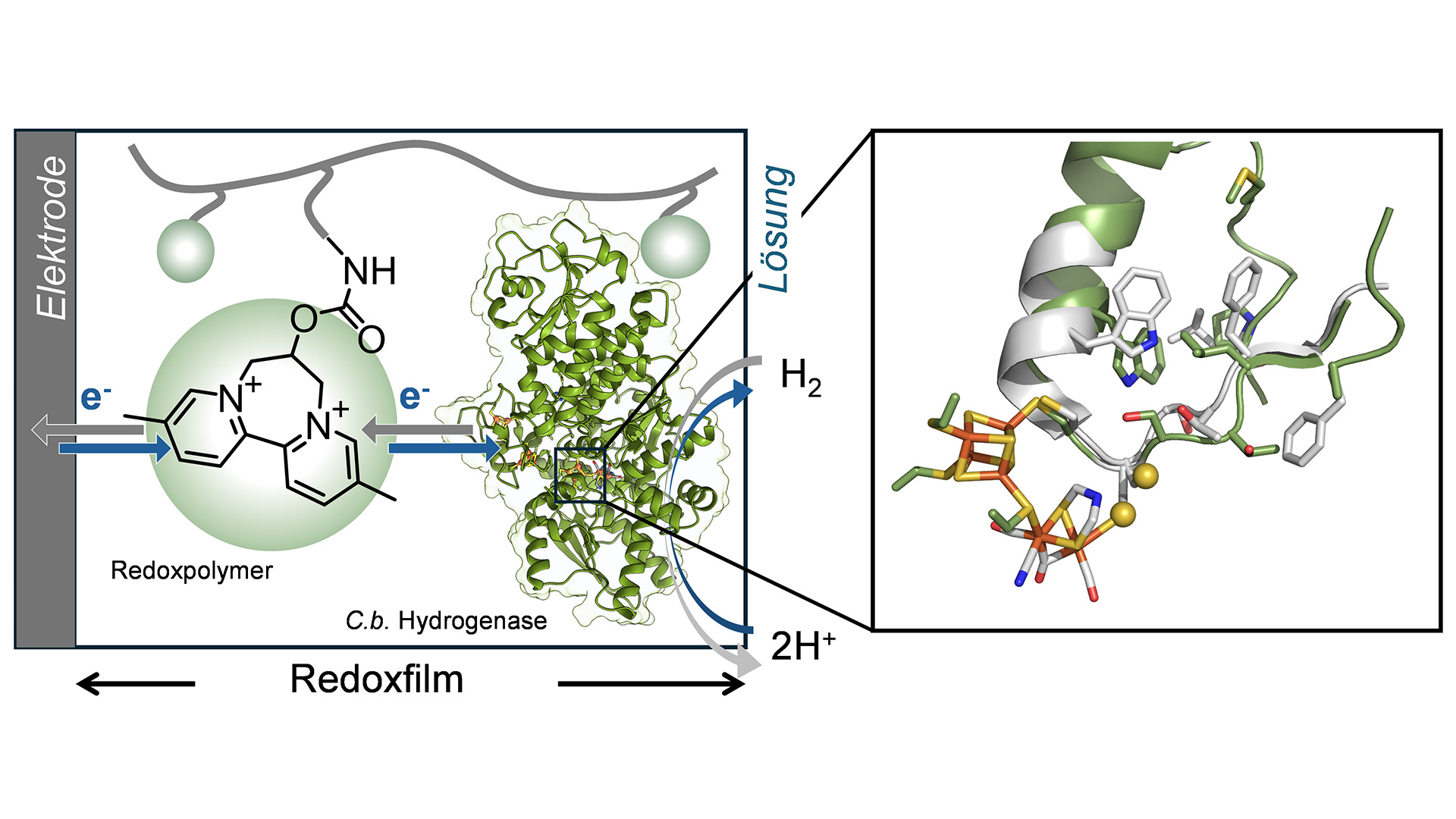
One of these, produced by the anaerobic bacterium Clostridium beijerinckii, has proved particularly interesting because its active site, thanks to a specific molecular mechanism, is not destroyed when exposed to oxygen. However, this enzyme seemed of little use in the context of hydrogen oxidation catalysis, because this protection mechanism renders the enzyme inactive with respect to hydrogen oxidation…
An important breakthrough: making the enzyme active and resistant.
In an article published in the journal PNAS, a new method is described that allows this particular hydrogenase to be deposited on an electrode under conditions that maintain its stability in the presence of oxygen. To do this, the enzyme is incorporated into a film about ten micrometres thick, made of a dendrimer (a branched polymer) capable of transferring electrons. By precisely adjusting the properties of this material, the intrinsic protection against oxygen no longer prevents the reaction with hydrogen.
This achievement, protected by a patent, is the result of interdisciplinary work combining physical chemistry, polymer synthesis, biochemistry and kinetic modelling. It paves the way for new generations of biological fuel cells that are more robust, more durable and potentially less expensive.
